The Ink and Intention Method
I created Ink and Agenda because I was tired of watching creative women try to force themselves into planning systems that were never designed for them.
You know the ones I mean.
The complicated productivity apps that look good on YouTube, but take three hours to set up.
The calendars that work fine for a corporate schedule , but not for a life that blends client work, a home, a partner, a dog, travel, and creative projects.
The endless digital pings, dings, notifications, and subscriptions that promise freedom but steal your focus.
I wanted a planning method that could hold all of it.
Client work.
Personal dreams.
Family life.
Soul work.
Rest.
(and maybe, not exactly in that order)
I wanted a method that honored the fact that some of us are multi-passionate, that some of us want to launch a product line and plant tomatoes in the same week, that some of us get our best ideas at 5 a.m., and some of us finally exhale at 10 p.m.
So I built one.
The Ink and Intention Method is the heart behind Ink and Agenda. It is the way I plan my own business and life, it is the way I help photographers, creatives, and solopreneurs reclaim their time, and it is the way I am building this brand.
This is not a productivity hack.
This is not a trend.
This is a rhythm.
You can use it for a week, a month, or the whole year. You can turn it into a planner, a binder, a digital course, or a quarterly reset. However you use it, the method stays the same.
Structure creates freedom.
Ink creates clarity.
Intention creates alignment.
Let’s walk through it together.

What Is The Ink and Intention Method
The Ink and Intention Method is a structured yet flexible framework that helps you plan with purpose, execute with clarity, and live with intention.
At its core, it is about putting your life on paper first, and then building systems that match the way you actually live. Not the way the internet says you should live.
This method blends three things:
Paper planning because writing things down connects your mind to your priorities in a way that tapping on a phone never will.
Mindset work because no planner in the world will fix a belief that you have to be busy to be valuable.
Strategic action because goals do not come to life without movement.
The method is made up of five pillars.
You can move through them in order or cycle through them every quarter.
Clarity
Structure
Intention
Execution
Reflection
Each pillar feeds the next.
Each pillar can stand on its own.
Each pillar can become content, a workshop, a planner insert, or a coaching call.
This is your framework.
Pillar One: Clarity
You cannot organize what you cannot see.
Most women who feel overwhelmed are not actually doing too much. They are just holding too much in their minds. Ideas. Open loops.
Client work. Home tasks. Content to post. Goals for the future. All of it is sitting in mental tabs, and none of it is making its way out.
Clarity is the process of getting it out of your head and onto paper so you can see it, sort it, and choose it.
Here is how to do it.
Step 1: The Honest Brain Dump
Sit down with paper.
Not your phone.
Not your laptop.
A real page.
Write everything that is asking for your attention right now.
Client projects
Household to-dos
Money to track
Content to create
Dog training
Gardening
Meal Ideas
Kid's school and sports schedules
Upcoming events to attend
Subscriptions to renew or cancel
Doctor's appointments to make
Your health goals
Your dream offers
Holiday plans and dreams
Trips to plan
Orders to return
Step 2: Sort for Season
Look at your list and circle what belongs to this current season.
Not someday. Not next year. Now.
Ask yourself:
What is a current commitment
What is revenue-generating
What is a personal non-negotiableWhat is a desire I can start now in a small way
This step matters because most overwhelm comes from pretending we can do all seasons at once.
We cannot. Inside Ink and Agenda, we honor seasons.
Fun fact: It wasn’t until this year that I truly leaned into the idea of honoring seasons. For me, that usually means thinking in 90-day windows, and when I started planning this way, everything shifted.
My capacity for work changes with the seasons. As the holidays approach, my bandwidth naturally shrinks, while the long, quiet days of winter and early spring become my most productive months.
Once spring turns to summer and we start traveling, my focus shifts again, home renovation projects take a back seat, and my creative output looks completely different.
Recognizing this rhythm helped me stop fighting my own energy and start planning with it.
Step 3: Define the Next 90 Days
Clarity without a horizon still feels foggy.
Once you have everything on paper, choose what belongs in the next 90 days.
Ask yourself:
What result do I want to see in 3 months
What would make life feel lighter
What would move the needle in my business
What do I need to finish before I can start something new
Now you have clarity.
Not a thousand things.
A focused list.
Clarity Outcome: I know what I am working toward, why it matters, and what can wait.
Pillar Two: Structure
Structure is not about being strict. Structure is about giving your brain somewhere to put things.
Creative women need a structure that breathes. We do not want to be told to do the same thing at the same time every day for the rest of our lives. We want a container that lets us flow inside it.
That is what this pillar does.
Step 1: Build Your Weekly Rhythm
Instead of planning day by day, plan rhythm by rhythm.
For example:
Mornings: deep work, content, creative projects
Afternoons: clients, meetings, errands
Evenings: home, dog, rest, journaling
Or:
Monday: CEO and planning
Tuesday and Wednesday: client and production
Thursday: content and marketing
Friday: admin and wrap up
Your rhythm can change every quarter.
The point is to have one.
When you have a rhythm, you can see where new commitments fit before you say yes. You can see where your dog training fits. You can see where product development goes. You can see where business and home overlap.
Step 2: Design Your Daily Touchpoints
Structure is not complicated.
It is consistent touchpoints.
Daily planning can look like:
Morning quick plan
Midday check-in
End of day close out
Each one can be five minutes.
What am I doing
What did I finish
What needs to move
This keeps your day contained.
Step 3: Use Paper and Digital Together
This is where Ink and Agenda is different.
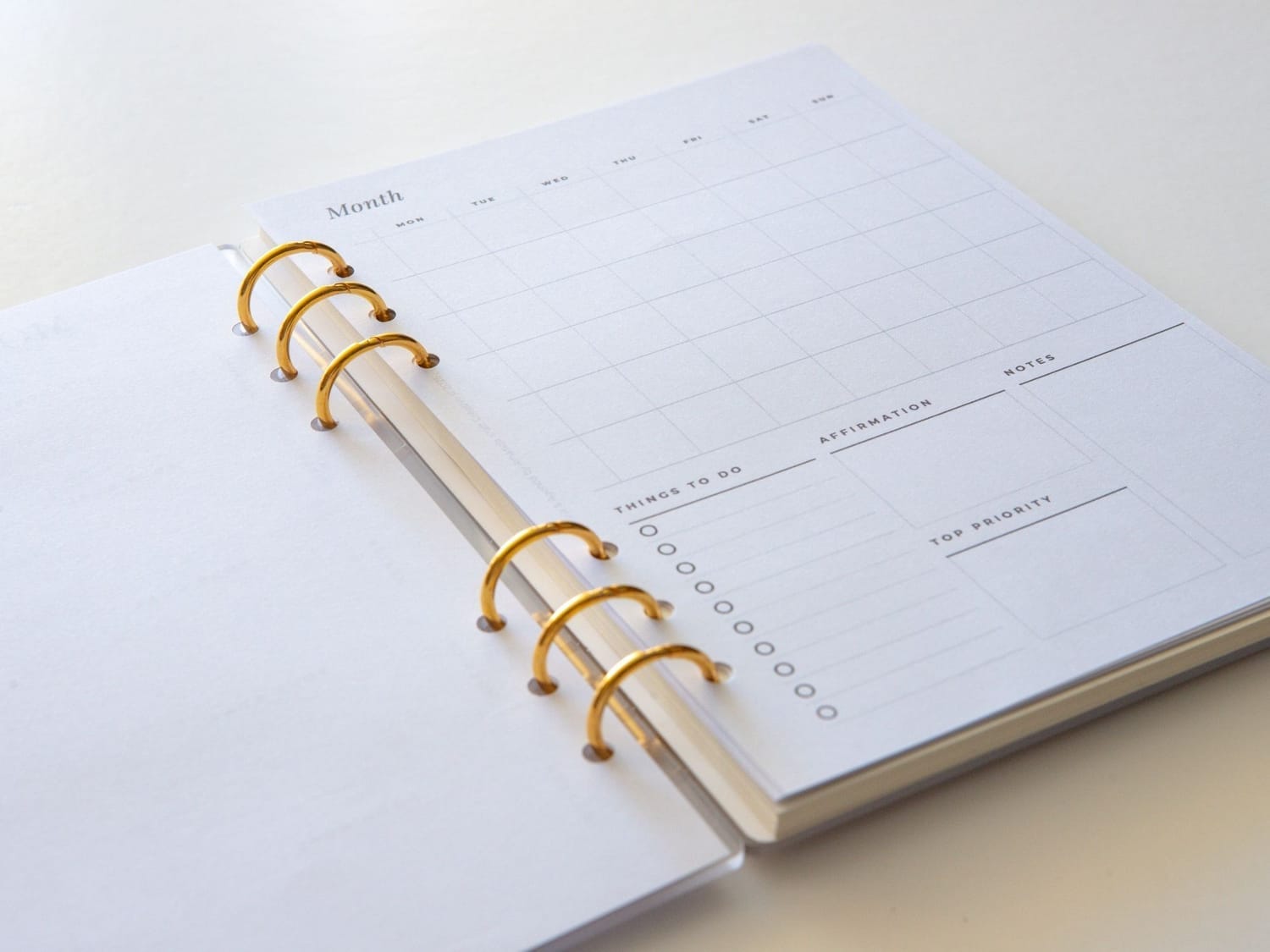
You do not have to choose between a digital calendar and a paper planner. You can use both on purpose.
Digital is for appointments, client calls, due dates, and reminders
Paper is for thinking, creating, mapping, reflecting
Your paper planner is not just a place to write tasks.
It is your creative operating system.
It is the place where you see your life at a glance. It is the place where you reconnect with your goals.
It is the place where you remember why you are doing all of this.
Structure Outcome: I have a rhythm for my week, a touchpoint for my day, and a place to put everything I am responsible for.
Pillar Three: Intention
This is the heart of the method.
Planning without intention becomes performance.
Planning with intention becomes alignment.
Intention is asking why before you say yes. It is connecting tasks to values.
It is remembering that you did not start your business to be busy all day.
You started it to have time freedom, creative freedom, and financial freedom.
Step 1: Reconnect to Your Values
Write down your top five values right now.
Not the ones you think you should have. The real ones.
Freedom
Creativity
Family
Service
Simplicity
Excellence
Faith
Community
Then ask, how is my current schedule honoring these values.
If it is not, this is where you adjust.
Step 2: Plan on Purpose
When you write your task list, add a small note beside each one.
Revenue
Nurture
Long term
Joy
Home
Admin
This helps you see what kind of day you are building.
If your list is all admin, no wonder you feel drained.
If your list is all revenue, no wonder you feel behind on content.
If your list is all nurture, no wonder you feel like nothing is moving.
Intention gives your plan a why.
Step 3: Protect Your White Space
This is important.
Creatives need white space.
Moms need white space.
Entrepreneurs need white space.
White space is not laziness. It is where the ideas arrive.
At Ink and Agenda, we do not fill every hour.
We plan capacity.
We leave room to breathe, to pivot, to take the dog to training, to go for a walk, to create a new insert that people have been asking for, to rest because we have had a full client day.
Intention Outcome: I know why this is on my list, and I am no longer planning out of guilt or pressure.
Pillar Four: Execution
Planning is cute.
Execution is how we pay our bills and bring our ideas to life.
This pillar is about taking aligned action without burning out. You already did the hard work of deciding what matters. Now your only job is to do it in a way you can repeat.
Step 1: Work in Small Windows
You do not need three uninterrupted hours to make progress.
You need a plan for the pockets of time you actually have.
15-minute task list
30-minute focus block
60-minute project block
When you plan in windows, you actually follow through because it fits your real life.
Step 2: Use the Power of Three
This is one of my favorite parts of the method.
Every day, pick three priorities.
Not seventeen.
Three.
One needle mover for business
One support task for life or home
One personal or wellness item
That is it.
Can you do more? Of course.
Will you feel successful if you get those three done? Yes.
Does this protect your nervous system from always feeling behind? Yes.
Step 3: Batch and Theme
Execution gets easier when you reduce transitions.
Batching does that.
Write three blog outlines at once
Design five printable inserts at once
Record voiceovers for all your reels at once
Do all client communication in one window
Do all home admin in one window
Batch cook once or twice a week
You already know this. The method simply gives it a place.
Execution Outcome: I am doing the right work at the right time, and I am not exhausting myself to get there.
Pillar Five: Reflection
Most planners and those who plan stop at execution.
Ink and Agenda does not.
Reflection is the part nobody talks about because it is not flashy.
It is not something people take photos of. It is not viral. It is not trendy. It is where the growth actually happens.
Reflection is how you learn.
Reflection is how you adjust.
Reflection is how you stop repeating the same month over and over and start making real progress.
Step 1: Weekly Review
Once a week, look at your planner and ask:
What did I actually finish
What felt good
What felt heavy
What kept getting moved to the next day
What did I say yes to that I did not need to
Write it down. This is data. Your life gives you feedback. You do not have to guess.
Step 2: Monthly Reset
At the end of the month, take 20 minutes and check in.
What goals moved forward
What projects stalled
Where did I waste time
Where did I make money
What routines did I fall out of
What support do I need next month
This is where you can do mini life audits like we talked about.
What fits?
What does not?
What are you carrying out of obligation?
What keeps catching you off guard?
Where are you running out of time?
Step 3: Celebrate Progress
Creative women forget to celebrate.
We move the goal.
We launch the product and then act like it was not a big deal.
We help a client hit a milestone and then tell ourselves we could have done more.
In this method, celebration is a practice.
Write three wins every week.
Write one thing you are proud of every month.
Write one thing you released.
Write one way you honored your energy.
Reflection Outcome: I know what is working, I know what to stop doing, and I am not repeating the same patterns.
The Transformation
Before the Ink and Intention Method
You were reacting to life and business
You were living inside digital chaos
You were trying to use systems that did not match your brain
You were saying yes because there was white space
You were exhausted from being busy without feeling accomplished
After the Ink and Intention Method
You have a clear rhythm for your week
You know what belongs in this season
You have a method for planning that supports your energy
You leave white space on purpose
You feel calm, focused, and creative again
This is the point.
Not to have a perfect planner.
To have a life that feels aligned.
How to Start Using the Method Today
Print or pull up your planner pages.
Work through Pillar One and get everything on paper.
Choose a weekly rhythm that fits your current season.
Pick three priorities per day for the next seven days.
Do a weekly reflection at the end of the week.
Repeat.
That is it.
Simple.
Intentional.
Repeatable.
You can take this method and shape it into something that fits your life.
Use it to bring calm to your mornings, flow to your workdays, and clarity to your goals. Let it be the foundation that keeps you grounded when life speeds up.
The Ink and Intention Method is more than a system. It’s your permission to slow down, realign, and start building a life that feels like your own.
This method was created to serve as your anchor — a framework that meets you where you are and grows with you.
Let it guide you as you plan, build, and create.
Every page you fill, every reflection you write, every small win you celebrate brings you closer to the life you’re meant to live.
That’s the power of planning with intention.
Hi, I’m Amanda Kraft — creative strategist, planner designer, and the founder of Ink & Agenda.
Before this brand came to life, I spent two decades behind the camera as an international wedding and portrait photographer, capturing stories in some of the most beautiful places in the world. My days were filled with creativity, but also with deadlines, travel, editing queues, and the constant pressure to keep up.
When I transitioned into my second chapter as a Virtual Studio Manager for luxury photographers, the pace didn’t slow down — it simply shifted. I was managing studios, systems, and schedules for other creatives while quietly realizing that mine were falling apart. My planner was packed, my to-do list was endless, and my spark was fading.
I reached a point where the business I once loved felt heavy. I was overwhelmed, overextended, and dangerously close to walking away from it all.
That was the turning point.
With my background in holistic health coaching, I understood the power of alignment — how energy, mindset, and systems all connect. So I went back to the basics: pen, paper, and presence. I built a framework that helped me organize my business, protect my creativity, and restore balance in my life. That framework became The Ink & Intention Method.
Today, I design planners and tools for women who want the same thing I was searching for — structure that creates freedom, systems that support creativity, and a planning method that feels human, not mechanical.
Ink & Agenda was born from the belief that you can build a successful, meaningful life without burning out in the process.
It’s for the creative who wants clarity without losing her spark.
It’s for the woman who is ready to stop reacting and start designing her days with purpose.
If this resonates, welcome home. You’re exactly where you’re meant to be.
Let us know what you think in the comments!
YOU MIGHT ALSO LIKE
Shop Inserts
Meet Amanda